Showing posts with label ouray. Show all posts

March 26, 2014

Spring Training

We see plenty of wildlife on Tabby Mountain WMA (Wildlife Management Area).  The area, about 100 square miles, is gated and closed to vehicular traffic from December 1 to May 1. 
We often see large herds of deer and elk on Tabby.  
Last week we saw a moose nibbling on gambel oak leaf buds.  He was on a hillside only about 100 feet away.  
He saw us but didn't seem to care.  
Ouray Wildlife Refuge is another wide open place to ride.  
The sandhill cranes are back along the Green River.  Between the squawking cranes and the Canada geese, silence is in short supply.

March 11, 2014

Spring Fever

We've been getting ourselves, Daisy, and the horses in shape with lots of rides in the past few weeks.
Daisy is so excited about getting out on the trails.  She insists on carrying a halter herself as we go out to get the horses.
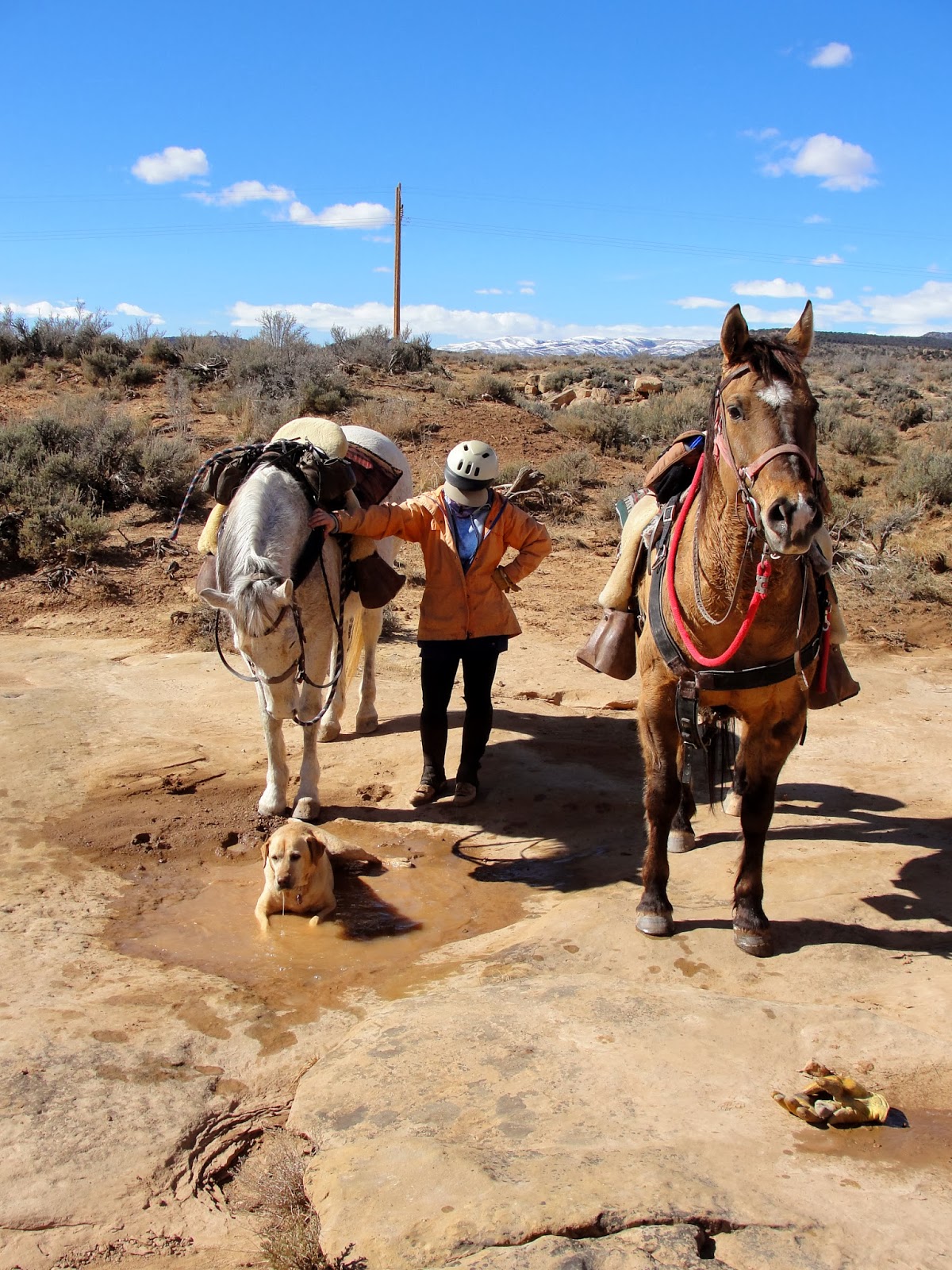
We went to Tabby Mountain a few times, where Daisy cooled off in potholes wherever she could find them.
A huge old pinon pine attracted Steve's attention.
In the Cedars, Daisy inspected the beaver dam and proclaimed the water fine for swimming.
Steve and Boss paused at a pond to admire reflections.
In Ouray Wildlife Refuge, we saw lots of Canada geese on the Green River, and heard sandhill cranes flying overhead.
A prairie dog peeked out of his hole,
And the wild horse herd that roams the area paused to stare at us.
Sometimes Mischief ponies along, and sometimes he just stays home.  While his compadres are being led out for a training run, Mischief maintains a low profile, hoping no one will notice him hiding out in the shed.  Is that a yawn, or is he laughing at his hard-working buddies?
He's our senior equine at 24, and he enjoys his days off!

February 17, 2012

Curious Pronghorn

We never know what we're going to see when we go out for a ride.  Near the Green River, we came up on a herd of pronghorn (Antilocapra americana). 
They stared at us for awhile, wondering what kind of animal we were.  Though these guys didn't seem interested in running, the pronghorn (also called a pronhorn antelope, or simply an antelope, although it actually isn't of the antelope family) can run up to 60mph and cover close to 8 yards in a single stride.  Wikipedia cites the pronghorn as the second fastest land animal, second only to the cheetah.  They have large eyes with a 320 degree field of vision. 
After a few minutes of keeping a close watch on horses and riders, they moved on, in no particular hurry.

April 12, 2011

An Osprey's Dinner

On a recent trip to Ouray Wildlife Refuge, we spotted this osprey hanging out atop a telephone pole.
 He was savoring his meal.  A fish from the Green River?
The osprey is sometimes called a sea hawk or fish eagle.  His diet consists almost exclusively of fish.  His eyesight is well adapted to seeing down into the water from above.  Prey can be sighted from as high as 130 feet.  He hovers, then plunges feet first into the river or lake to catch his supper. 
Osprey usually mate for life.  Their typical lifespan is 7 to 10 years. 

March 21, 2011

Snow-Free (Almost!) Refuge

Finally, we have a place to ride locally.  The dirt roads are clear, with the ground still moist and soft.  The above photo was taken at Leota Overlook with the Green River below us.  As you can see, one big patch of snow remains. Both horses are looking a little rugged, still hairy, and sweaty from a run up the hill.
We saw a big group of Sandhill Cranes down near the river, but the photos didn't turn out.
This was Mischief's first ride this year.  (He's older, so I haven't taken him on the multi-day rides in Canyonlands.) He seemed to enjoy going for a run.  On his break, he checked out Steve for treats.

November 19, 2010

Wild Horse Bench

To get in one more ride before a cold/snow front arrives this weekend, we bundled up and headed to Wild Horse Bench, south of the small Ute community of Ouray.  Annual precipitation in this area is 6.7 inches.
We didn't see any wild horses, but we did see manure piles typical of mustangs.  Boss is checking out the strange horse smells:
In the background of the above photo, an oil rig looms.  
The desert environment has lots of big anthills that always have a barren circle around them:
We can see these sand circles on Google Earth when scanning at 1000 feet.  In the photo above, you can see the Uinta Mountains in the distance.
We followed antelope trails across the desert:
Do you see the narrow path in front of Mischief? 
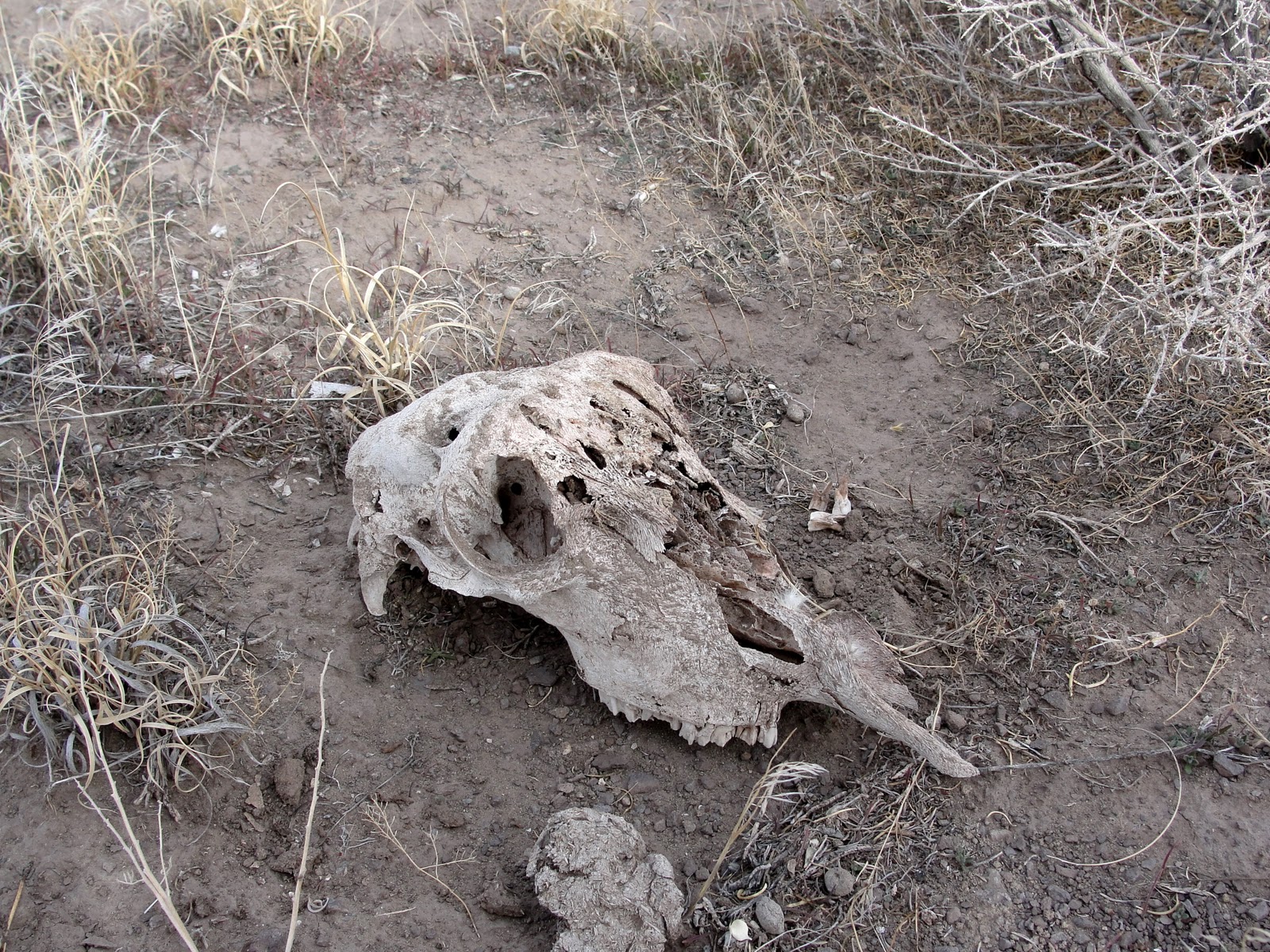
This antelope didn't make the trip:
We rode to the Green River, a welcome stream of life running through this arid land:

October 10, 2010

Guns and Cockleburs

Yesterday was the first day of the general elk hunt, so we stayed out of the mountains and opted to ride in the Ouray National Wildlife Refuge.  To our surprise, we heard guns there, too.  Apparently, it's some kind of waterfowl season.  Is it just me, or does a wildlife refuge hunt seem like an oxymoron? 
We began by climbing high on a ridge overlooking the Green River and its riparian corridor. 
When we reached the highest part of the ridge, we started down, following an old, eroded roadbed through desolate cliffs to reach the river:
The river supports rich vegetation: 
Trails near the river are shaded by cottonwoods, now turned gold: 
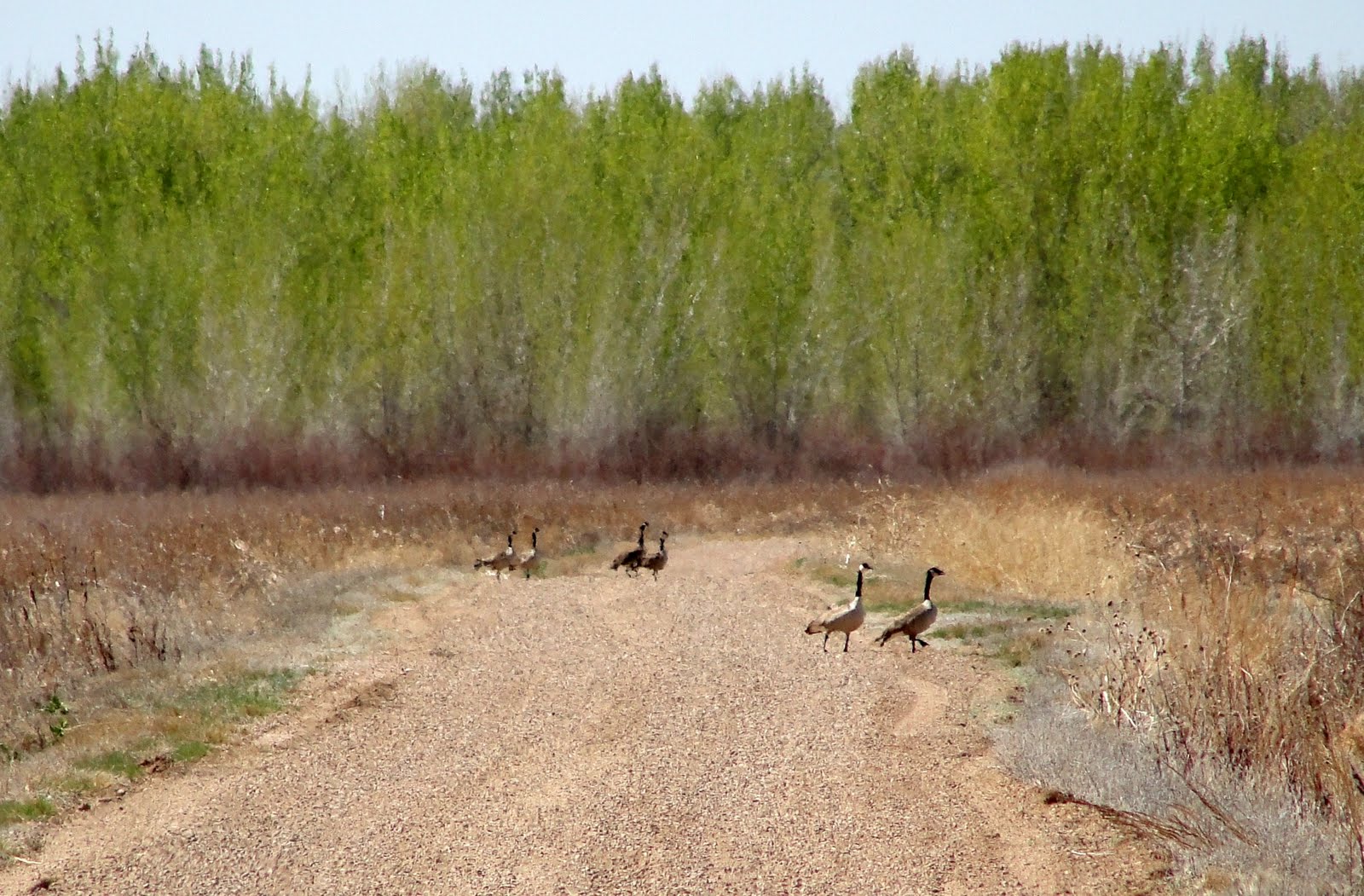
We saw Canada geese:
and a flock of sandhill cranes:
The one downside was accidentally travelling through a morass of these:
The horses' tails collected hundreds of them.  Oh, well, their tails needed brushing anyway.  No harm done.  Next time we'll avoid the burrs.

May 12, 2010

Prickly Surprise

As we continued down the road at Ouray National  Wildlife Refuge, we saw
geese strutting in pairs,
and a heron on the wing.
When we reached the cottonwood trees growing along the Green River, we looked up to find

Mr. Porcupine! He seems to be having his usual bad hair (quill?) day, but that doesn't stop him from enjoying a siesta after lunch.
In another tree, we found
Mrs. Porcupine, perhaps?

May 11, 2010

Wetlands in the Desert

Ouray National Wildlife Refuge is on the Green River near an historic Ute Indian community called Ouray, named after a respected Ute leader.
Expansive wetlands were noted here back in 1869 when John Wesley Powell floated down the Green River and explored the area.
Now the refuge is managed as a series of diked ponds that are flooded artificially in spring to provide wetlands for migratory birds.  The Green River has been dammed upstream at Flaming Gorge Reservoir and the area no longer floods naturally.
Desert grasslands and sage, populated by antelope, deer, prairie dogs, and jackrabbits, (and sometimes elk in the winter) surround the refuge marshes.  To the north, you can see the snow-covered Uintas, rising to over 13,000 feet.
In the marshes, waterfowl are abundant.
On a recent walk, we saw Great Blue Heron,
long-billed curlew,

flocks of these little birds, which I think are Wilson's phalarope, and numerous geese and ducks.In my next post, we'll stroll under the big old cottonwoods that grow along the river and see what we can find there.
Many thanks to those who checked on my blog and emailed while we were gone.  We're not quite back in the saddle, literally, but we will be soon.
It's good to be home!

April 13, 2009

Big Pack Mountain


On Friday, we trailered the horses south of Ouray, Utah (named after a Ute leader of the late 1800’s, now part of the Uintah & Ouray Reservation), and across the Green River to Willow Creek. This area is all BLM land, with a lot of oil and gas wells and a few active pumping units. We parked next to a bubbling spring that adjoins a small pond, saddled up, and headed out across a dry desert landscape.
The roads were sandy and allowed for easy cantering for miles at a time. In the first hour, we covered 10 miles.
After that, not only Daisy, but even the horses were ready to cool off by eating snow.

Our destination was Big Pack Mountain, at 6600 feet. At this time of year, we can’t go much higher without reaching a prohibitive amount of snow on the trails, so desert rides like this one are our best, and warmest, option.

We rode along this ridge. (Enlarged, you can see Steve, Boss and Daisy.)

This trio reached the top first.

From the high point, the view was of vast, wide open spaces, one of Utah’s greatest features.
On the way back, we had views of the High Uintas, our summer riding heaven.
Clocking in at 21 miles, 1600 feet elevation gain, in about 3.5 hours, this was our most ambitious ride so far this season.
For visions of more worlds, click here.

LinkWithin

Blog Widget by LinkWithin