Showing posts with label flora and fauna. Show all posts

June 9, 2012

Living on Wildflowers

We rode to the top of Lake Mountain yesterday.  Wildflowers were out all along the way. 
A red-tailed bumblebee, Bombus ternarius, fed on a mountain dandelion.
This less colorful bumblebee preferred the golden pea blooms. 
Do you see something unusual on this iris? Steve did, enough to dismount and take a second look.
On closer inspection, you can observe this goldenrod crab spider Misumena vatia, eating a wasp.  Look closer still.  Do you see the baby spider to the right?  It's getting a survival lesson from mom.  I hope it's taking notes. These spiders can be either yellow or white, changing color over a couple of weeks by secreting or excreting yellow pigment. They don't build webs, but hide and ambush their prey.
A rocky mountain parnassian perches on a dandelion. 
This western swallowtail checks out the iris nectar. 
Across Gull Lake, an elk was wading in the water.  When we rode within about 500 yards, it splashed out of the water, leaving a visible wake, and disappeared into the aspen forest. 
Back at the trailer, a trusting Daisy enjoys Boss's shade.   Boss usually moves along when grazing, but with Daisy there, he didn't take a single step.  He seemed to know she was there and stood protectively over her.

June 13, 2011

Wildflowers in the Foothills

Balsamorhiza sagittata
Balsamroot is a familiar plant,
Balsamorhiza hookeri
but I never realized there was a second species with leaves that look completely different. (In the lower left of the above photo you will also see Deathcamas's white flower.)
? hybrid balsamroot ?
I thought the plant with the pinnate leaves had to be something other than balsamroot until I noticed a hybrid with leaf characteristics of both species!
Gee, isn't botany fun?!  And confusing, a lot of the time.
Cryptantha
We have seen the above flower many times, but couldn't identify it. I think I finally have the genus name right. I'm not even going to attempt to add a species name.
Lewisia
We had not seen this one before.  It looks a lot like bitterroot, state flower of Montana.  Indeed, the genus turns out to be the same. 
All of the above photos were taken in early June on the south slopes of the Uintas,7200-8500 ft.

June 1, 2011

Bird and Bees

Let me tell you 'bout the birds
Mr. Lazuli Bunting
Mrs. Lazuli Bunting
Mr. Goldfinch
Mrs. Goldfinch
and the bees
Honey Bee on Chokecherry
Honey Bee on Apple Blossom
and the flowers and the trees
a
Crabapple Tree in Bloom
And the moon up above ...
You may have thought I was going to tell you about a thing called "Love", as the song goes.  But I'm not taking this any farther.  I've created the atmosphere.  You're on your own from here!

May 27, 2011

Blooming in the Wild

The high desert of the Wild Mountain area is in its early spring bloom. The photo above is a panorama taken from 8600 feet, looking down on Diamond Plateau with Split Mountain in the background just to the right of center.
Springbeauty carpeted the ground at 7500 feet.  This flower is one of the first to bloom after the snow melts.
We also saw phlox,
bluebells,
Nuttall's violets,
and balsamroot.
On the hillsides at around 8000 feet, barrel cactus offered unexpected beauty.
Beetles took advantage of its nourishment.
Amost back to our trailhead, we saw this group of young bucks, apparently a bachelor herd.  Their velvety antlers are growing.   The one on the right seems to have only one antler.  I wonder if the lady deer will scorn him for being lopsided...

September 8, 2010

Oldies

Aspen graffiti is common on Utah hiking trails.  I like to check out the larger trees and look for dates.  Jim and L.C. made their mark in 1912.
This carving has been around even longer. Obviously, people felt the need to leave a lasting impression.  As far as I can tell, the names and dates haven't harmed these trees, but I do wonder if a deep carving might provide an entry for disease or bugs. 
I'm not sure what this says, but it was on a very old tree that had fallen across the path.
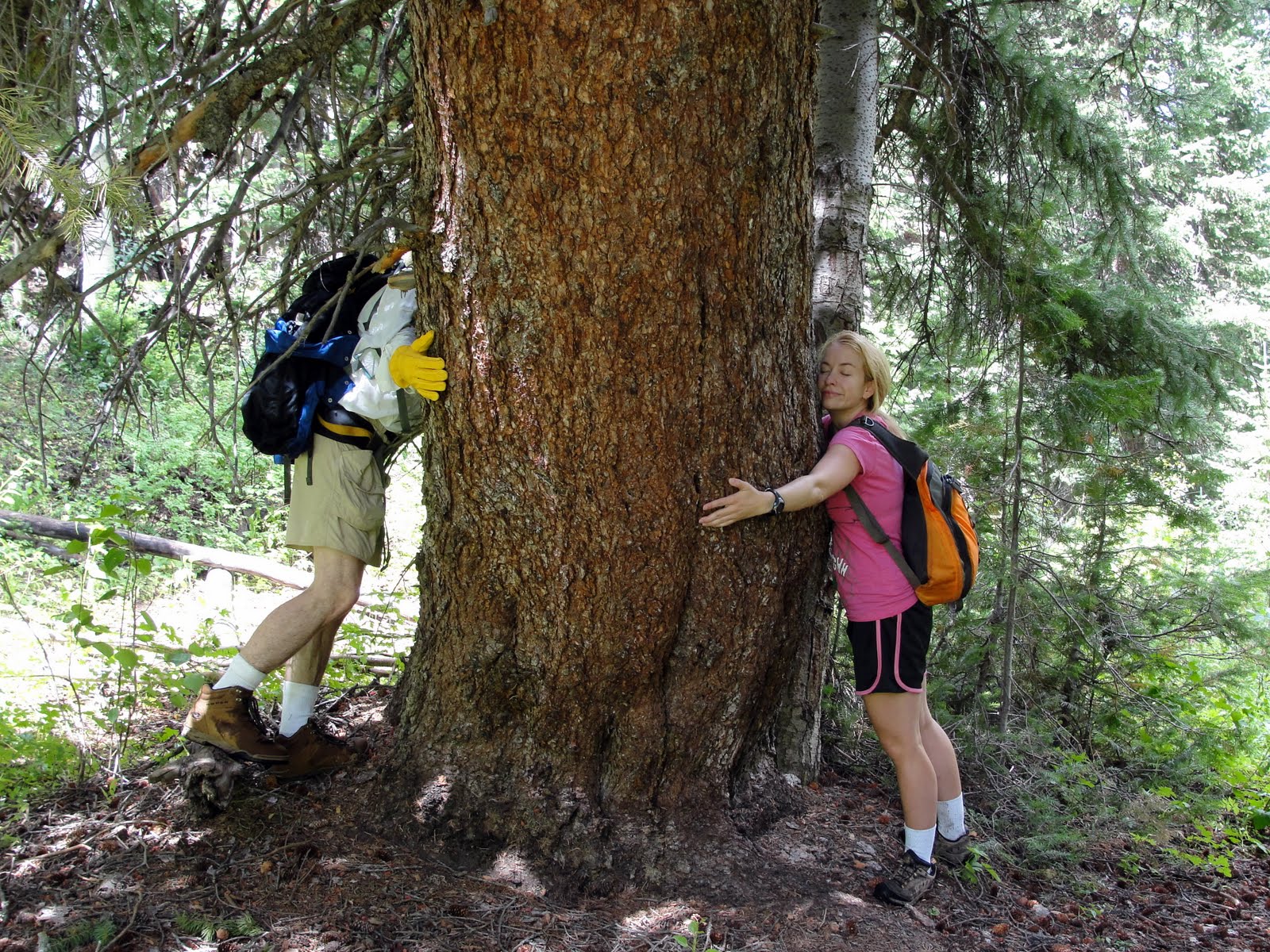
Who are these crazy tree-huggers, and what are they up to?  Why, it's Steve and our daughter, measuring the circumference of an Engelmann spruce tree we saw on our hike up Days Fork in Big Cottonwood Canyon, east of Salt Lake City.
The tree is 13 feet in circumference, at the upper end of size for the species.  We estimate it's about 200 years old. 

August 31, 2010

Into the Wild

Last week, we took our son Eric on his first horse pack trip.  He's done plenty of hiking, both in Utah and in the Seattle area where he lives, but 3 days on horseback was a new element. 
Steve rode Coco, and Eric rode Boss, our calmest mount.  (The orange wear is because it's bow hunting season.) All of the horses were loaded with overnight packs, which included light backpacking-type overnight gear and food for the humans, plus hobbles and highlines for the horses.
Mischief and I were ready to go, too.
Signs were a bit confusing in places (note the crossed-out direction).
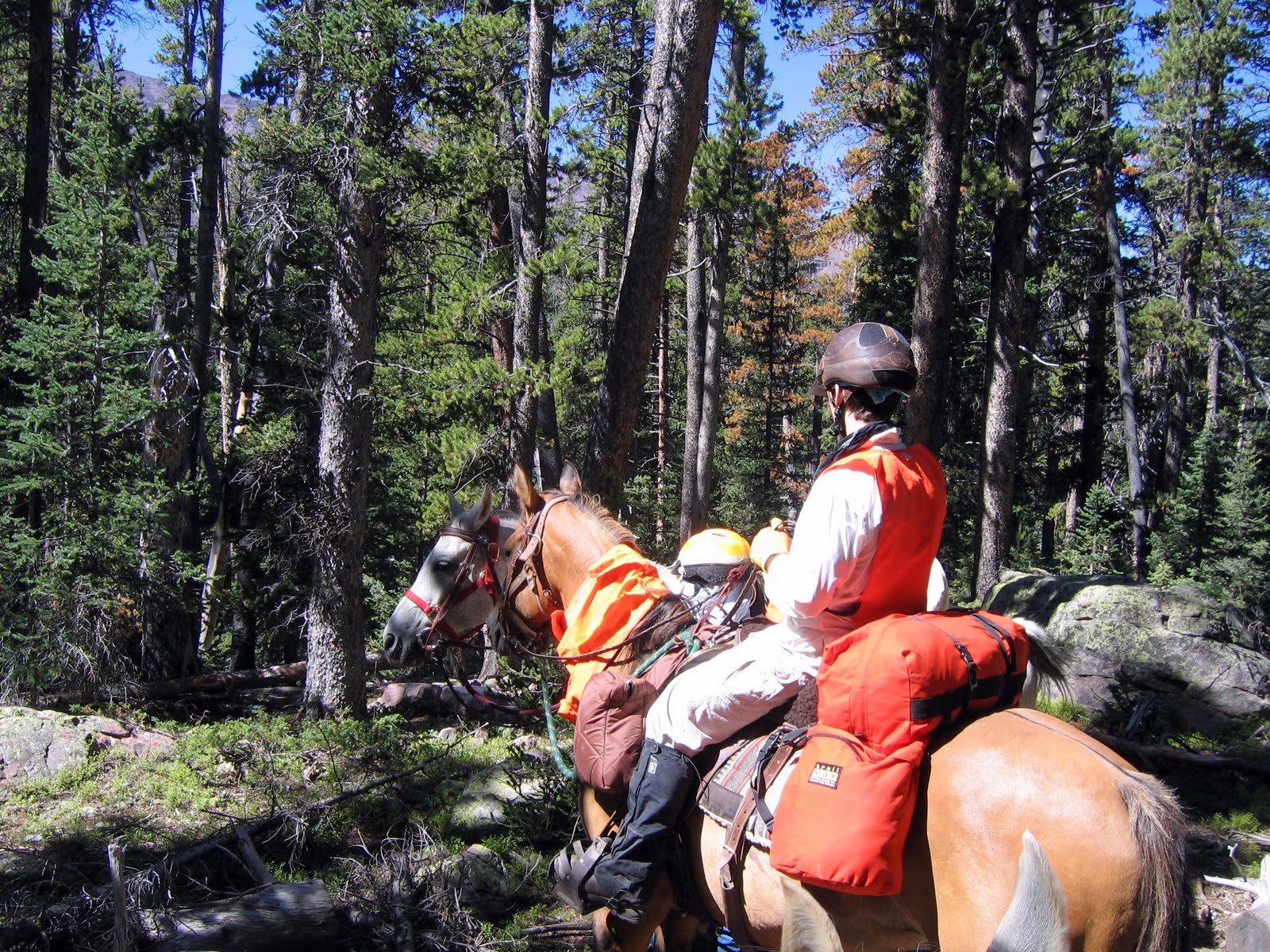
The trail wound through a spruce forest:
and past serene lakes.
The meadows and even the steep, rocky slopes delighted us with end of summer wildflowers:
(bog gentian),
(cinquefoil),
(harebells),
We ascended from the 10,200 ft trailhead to the rocky Fox Queant Pass (11,400 ft/ about 3400 m):
where we entered the Uinta Wilderness Area. 
Don't worry, the horses had boots on, and the humans got off and walked wherever the going was especially tough.
Join us in tomorrow's post, as we continue our "survival" adventure!

August 7, 2010

A Potpourri of the Weird

We've had some unusual sightings on Uinta trails this summer.  Here is a naked broom-rape Orobanche uniflora.  It's a parasitic plant containing no leaves or chlorophyl.
It gets its nutrients from other plants such as lanceleaf stonecrop Sedum lanceolatum, which were plentiful in the area.
The stonecrop doesn't look that tasty to me, but Wikipedia says the leaves of all stonecrops store water and are edible.  Hmm, I learn something new every day.
 On the same hike, we ran across this carving on an aspen tree:
1844?  Is that possible?  A mountain man might have been here then.  That's about it.  The other question is whether an aspen tree could live that long.  I read that they can live about 150 years, so the date is a little bit of a stretch, tree-wise.
Assuming the carver wasn't being purposefully deceptive, maybe it's 1944, distorted by time.  Yes, that's more likely. But who the heck is K.B.? 
Now, consider this trough:
It seems to have been carved out of a tree trunk, a long, long time ago.  Someone put tar on the inside to make it waterproof.  Could this be the work of the mysterious K.B.?
We saw these fossils on a hike in Albion Basin near Alta Ski Resort, at 11,000 feet: 
They look like sea shells.  So, how did organisms from the sea get to the top of a mountain?  Seas dry up, mountains rise, and voila, we have fossils that seem incredibly out of place.
Sometimes the natural world is stranger than fiction, if we take the trouble to look closely and examine what we find.

LinkWithin

Blog Widget by LinkWithin