
Showing posts with label The Cedars. Show all posts
Showing posts with label The Cedars. Show all posts
July 17, 2012
Two Chicks!
The second nighthawk chick hatched a day after the first one.
 Chick the Younger is now 3 days old. Mama seems to hover over them most of the time. We thought the chicks would quickly become mobile and hide in the junipers, but with their amazing camouflage, they are able to hide in plain sight.
In this video, Mama does her injured act to lure us away. When we follow her, she hisses at us like a snake in an attempt to frighten us. Admiring her protective instincts, we left her to do her thing and take good care of the babies.


July 13, 2012
Nighthawk Down
On a ride in The Cedars about 10 days ago, we first saw this bird:
 The nighthawk (about the size of a robin) flew up from the ground, but she didn't go very far.
 A few days later, we saw her again. Steve scanned the area and found her "nest". The eggs are laid on bare rock and sand, but they're so well camouflaged that they're hard to find.
 We returned daily, sometimes twice a day, hoping to see the hatchlings in the first 24 hours. After that, they are mobile and would probably hide in the junipers.
Our persistence paid off. Here's the video of our discovery:
And a close-up of the chick:
 What a cute little fuzzball. His head is on the left. You can see his closed eye.


Our persistence paid off. Here's the video of our discovery:

March 2, 2012
Cliffy Discoveries


 |
| Petroglyph, zoomed in. |
Since the nests are in ideal locations, maybe the eagles have raised young there since the time the petroglyphs were carved, and perhaps the petroglyphs were marking the spots as special or sacred. It's interesting to speculate.

The above petroglyphs were not near a nest. Man chasing deer, with extra large human footprint? That's my best guess. What do you think? The figure above and to the left looks a little like a jackrabbit to me.


July 19, 2011
The Eaglet has Risen


Later we see both golden eagle parents, but they fly away too quickly for a photo.
March 23, 2011
Cedars and Cobblerocks


In a section on hoof care, he suggests keeping a horse in a paddock with hoof sized cobblerocks to strengthen the hooves. We don't have any cobblerocks in our pasture, but riding over rocky terrain serves the same purpose. Cobblerocks are great for barefoot hoof conditioning.

November 14, 2010
Sand Skiing
I was trying to take a photo of Boss going down a steep, sandy hill,
 but Mischief had to get into the act. Mischief seemed to ski down on his back hooves:
 He scampered off after his slide, quite pleased with his independent run.
 Fortunately, he didn't go far. I was counting on a ride back to the trailer!
 but Mischief had to get into the act. Mischief seemed to ski down on his back hooves:
 He scampered off after his slide, quite pleased with his independent run.
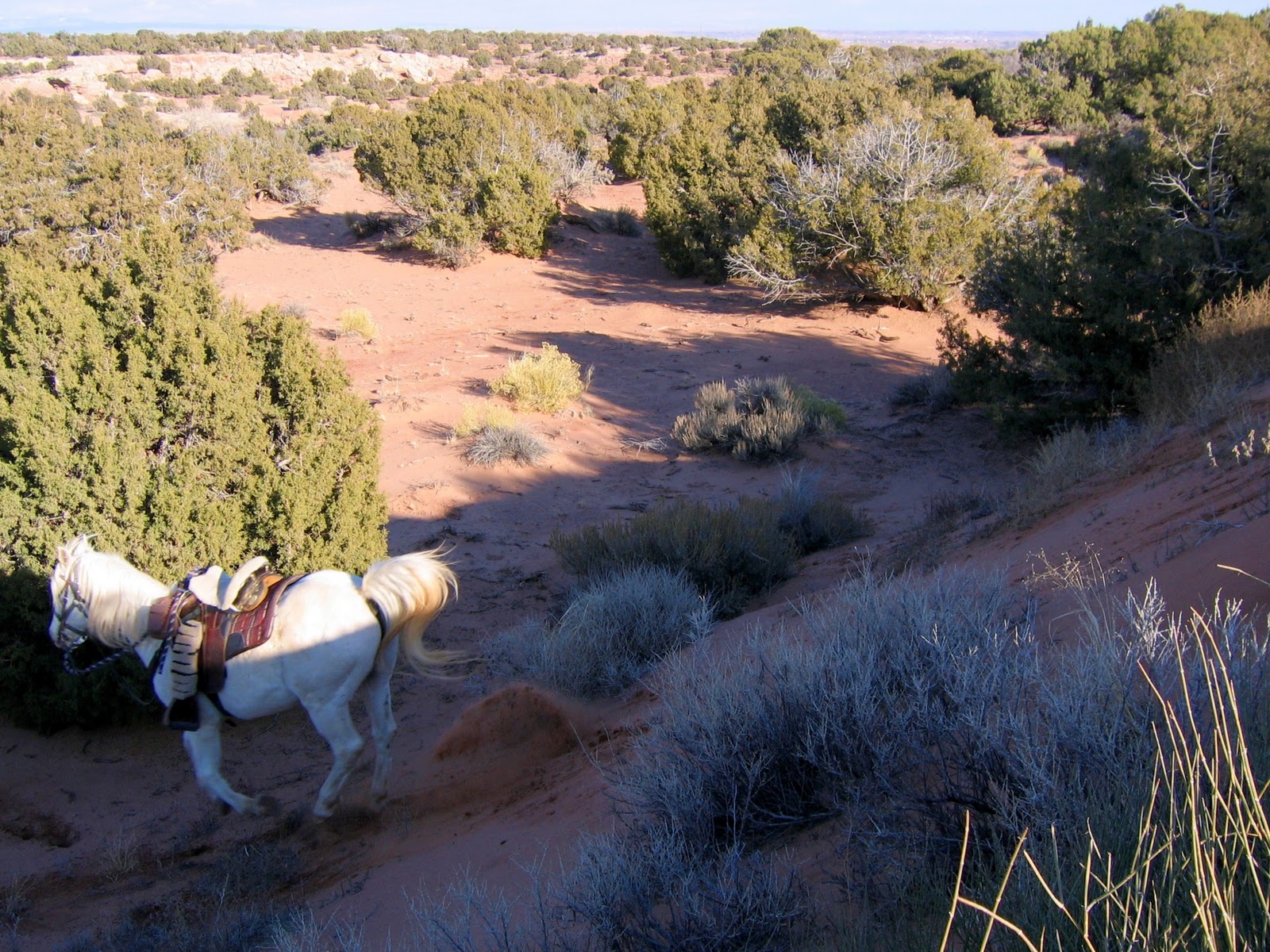 Fortunately, he didn't go far. I was counting on a ride back to the trailer!
November 12, 2010
Desert Friends
On a walk in the desert, you never know whom you might meet.
 Daisy is thrilled! The snake, not so much...
 heading for a hiding place under a juniper tree.

 Daisy is thrilled! The snake, not so much...
The day was cool and this Great Basin Gopher Snake ( don't worry, it's not poisonous) was moving slowly,
heading for a hiding place under a juniper tree. 
Daisy soon forgot about the snake and started sniffing for jack rabbits again.
June 21, 2010
The Hills are Alive...
Sand hills, that is.
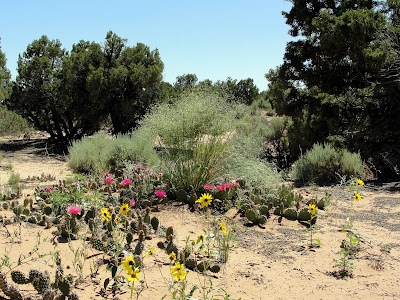 In the afternoon heat, most critters are hanging out in the shade, but we see signs of them everywhere.
 Lizard tracks (the line is from their dragging tails),
 beetle tracks (These prints look like mini-bicycle tire tracks, don't they?)
 and rabbit tracks.
 These arcs look like a critter traveled in circles, but the effect is from wind swirling the grass blades through the sand.
 The ants are out and busy, storing supplies for a rainy day (fat chance in the desert!) or maybe for the winter's chill.
 In the afternoon heat, most critters are hanging out in the shade, but we see signs of them everywhere.
 Lizard tracks (the line is from their dragging tails),
 beetle tracks (These prints look like mini-bicycle tire tracks, don't they?)
 and rabbit tracks.
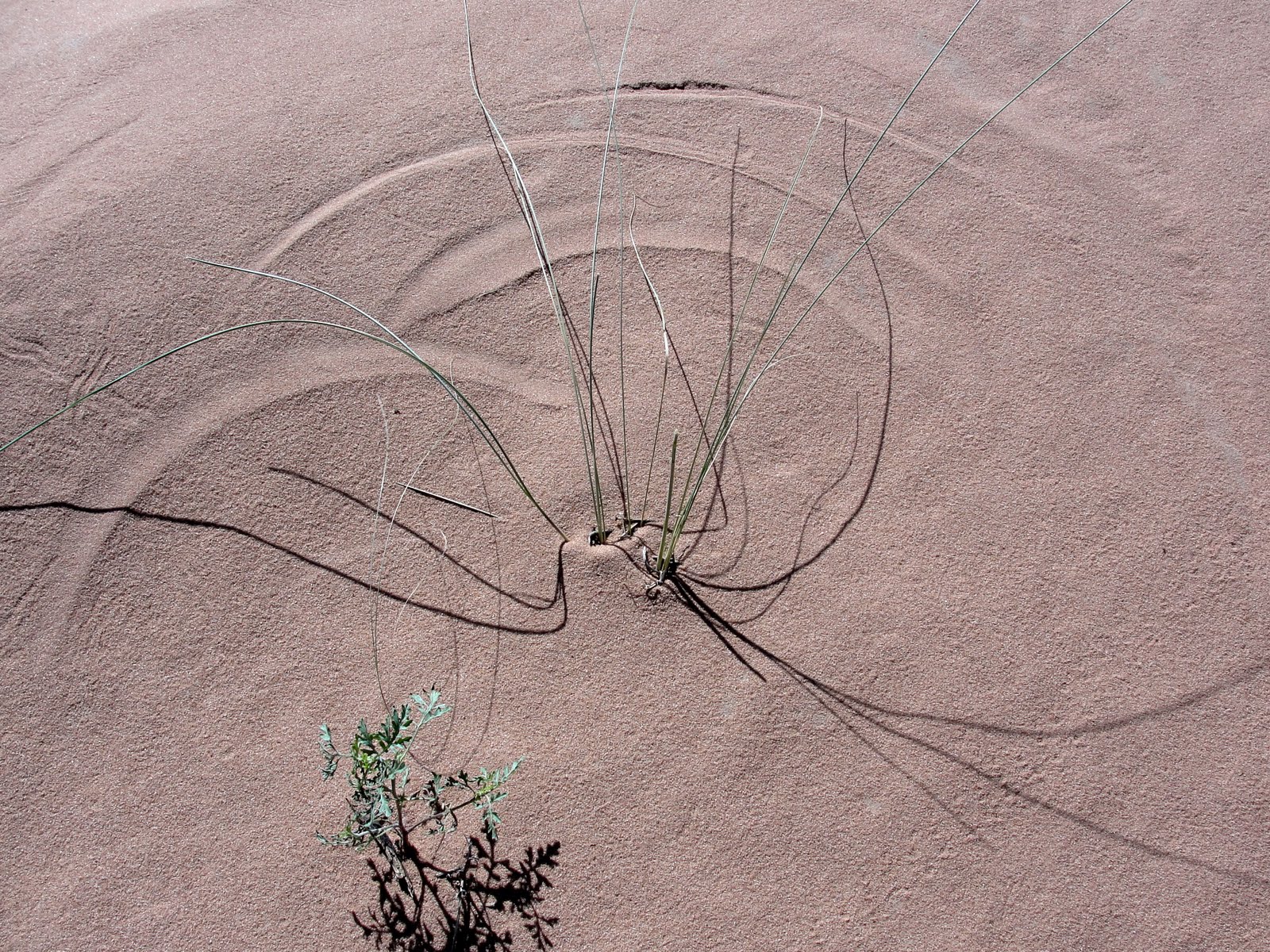 These arcs look like a critter traveled in circles, but the effect is from wind swirling the grass blades through the sand.
 The ants are out and busy, storing supplies for a rainy day (fat chance in the desert!) or maybe for the winter's chill.
June 19, 2010
Flowers in the Sand
The high desert is in bloom, full of prickly pear cactus blossoms,
 pink.
 and yellow.
 Sunflowers reach for the sky,
 chicory provides a bit of blue,
 and the yucca plants get fancy.
 The delicate sego lily, Utah's state flower is yet another special treat. (Those are little bugs on it. I guess they wanted a treat, too!)
 pink.
 and yellow.
 Sunflowers reach for the sky,
 chicory provides a bit of blue,
 and the yucca plants get fancy.
 The delicate sego lily, Utah's state flower is yet another special treat. (Those are little bugs on it. I guess they wanted a treat, too!)
June 7, 2010
Horny Toads and Winged Docks
There is always something new to discover in the world of nature.
 Last week, we saw this lovely flower for the first time. It's a winged dock (Rumex venosus). Wild-begonia is another name, although this plant is not related to the genus Begonia.
 These blooms were covering a hill in the Cedars near our house. They seem to love dry, sandy conditions. If we had not ventured off of our familiar beaten path, we never would have seen them.
 In the same vicinity, we also saw yucca plants, almost ready to bloom.
 We've seen a few of these guys before. He's a desert horned lizard (Phrynosoma platyrhinos), commonly known as a horny toad, although he is not a toad. Isn't he cute? These creatures subsist on ants and other slow-moving insects.
**A blogger comment from Ryan O'Donnell at http://www.birdingisfun.com/ says the above is actually a Greater Short-Horned Lizard (Phrynosoma hernandesi). Since I'm not a biologist and he is, I think he's got it right!
 To learn about an amazing array of other worlds, click here.
 Last week, we saw this lovely flower for the first time. It's a winged dock (Rumex venosus). Wild-begonia is another name, although this plant is not related to the genus Begonia.
 These blooms were covering a hill in the Cedars near our house. They seem to love dry, sandy conditions. If we had not ventured off of our familiar beaten path, we never would have seen them.
 In the same vicinity, we also saw yucca plants, almost ready to bloom.
 We've seen a few of these guys before. He's a desert horned lizard (Phrynosoma platyrhinos), commonly known as a horny toad, although he is not a toad. Isn't he cute? These creatures subsist on ants and other slow-moving insects.
**A blogger comment from Ryan O'Donnell at http://www.birdingisfun.com/ says the above is actually a Greater Short-Horned Lizard (Phrynosoma hernandesi). Since I'm not a biologist and he is, I think he's got it right!

May 27, 2010
Desert Survivors
Life in the desert is a struggle for survival, but some species adapt quite well.
 Here is the sage lizard. See how it blends into the environment, hiding out beneath the junipers? Its predators are hawks, snakes, and perhaps coyotes.
 This lizard is very quick. When startled it usually darts into the shade, where it is harder to see. Sometimes it will freeze, which is fortunate because it's the only chance we have to get a photo.
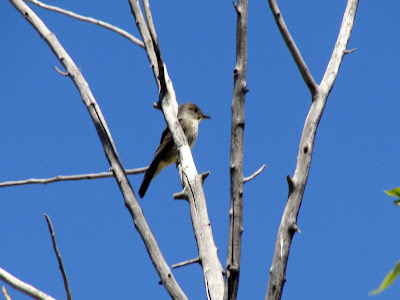 This little bird seemed to have a nest nearby and didn't flit away instantly as its kind usually does. I think it's some variety of flycatcher. We see them in the tops of the juniper trees. They probably eat the juniper berries and use the tree branches for shelter and nesting.
 I believe this is a lark sparrow. We saw two of them hopping along in the sand. This one stopped on an ant hill and pecked up a few of the tasty (I assume) insects.
 Here is the sage lizard. See how it blends into the environment, hiding out beneath the junipers? Its predators are hawks, snakes, and perhaps coyotes.
 This lizard is very quick. When startled it usually darts into the shade, where it is harder to see. Sometimes it will freeze, which is fortunate because it's the only chance we have to get a photo.
 This little bird seemed to have a nest nearby and didn't flit away instantly as its kind usually does. I think it's some variety of flycatcher. We see them in the tops of the juniper trees. They probably eat the juniper berries and use the tree branches for shelter and nesting.
 I believe this is a lark sparrow. We saw two of them hopping along in the sand. This one stopped on an ant hill and pecked up a few of the tasty (I assume) insects.
Subscribe to:
Posts (Atom)
LinkWithin
